Violin Lessons
Built on the right foundation.

The violin rewards precision. It punishes shortcuts. And it gives back — in ways that few other instruments can — when a student has been given the right foundation from the very first lesson. That foundation is exactly what we build here.
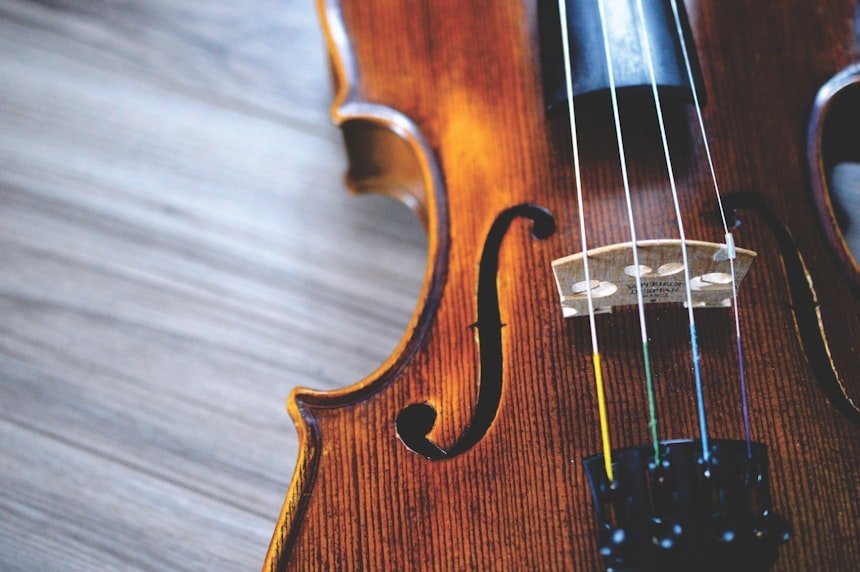
Brown and black violin — classical instrument close up
The violin is one of the most technically demanding instruments to master — and one of the most rewarding when the right foundation is in place.

The evaluation comes first — always

After 25 years of teaching violin, the single most consistent pattern is this: if your child has been playing for a year or two and progress feels stuck, there is almost always a reason. And it almost always starts with something physical — a bow hold that was never corrected, a left wrist that collapses under string pressure, a posture that tightens with every passing month. These are not small problems. They compound. They are far harder to correct at year three than they are to prevent at week one.

This is why every student at Soul Music Lessons begins with a private evaluation before anything else. We assess your child’s posture, bow arm, left hand position, and intonation awareness. If they have played before, we identify the specific habits — and there are almost always some — that need to be addressed before we build anything new on top of them. The evaluation is diagnostic, not performative. It tells us exactly where your child is, and exactly what the right path forward looks like.

The curriculum that follows is not generic. It is built around what this student needs — their current physical development, their goals, and the technical gaps that stand between where they are and where they want to go.

On foundations and the pieces your child loves

Your child may arrive with a piece in mind — something they heard and fell in love with. That motivation is valuable, and we never dismiss it. But here is the truth: the pieces that matter most will sound the way they deserve to sound only after the foundational technique is in place. Most parents are surprised by how fast that foundation comes together when it is built correctly. The foundation comes first. The music follows — sooner than you expect.

Who studies violin here
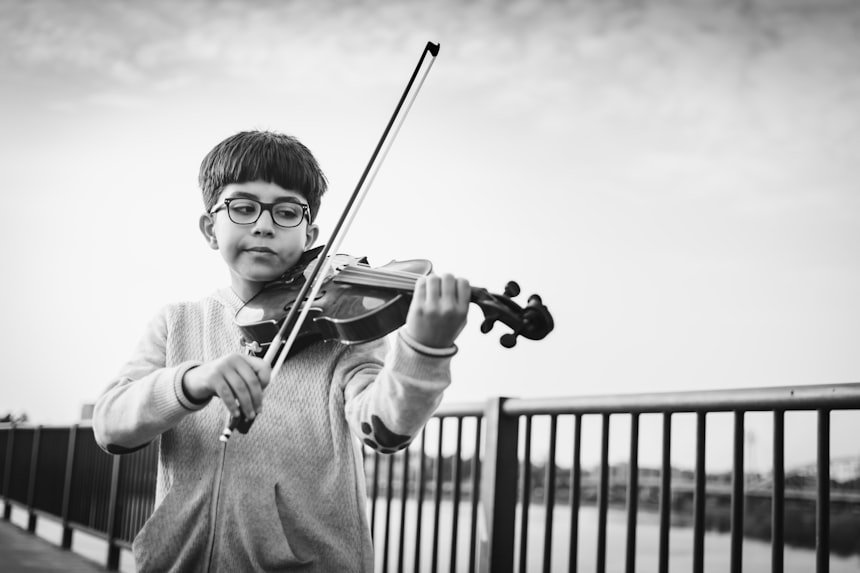
Boy playing violin — focused young student with bow on strings
Every student who walks through the door is different. The evaluation is how we find out what this particular student needs.
The young beginner
Ages 5–9. Learning by ear first, building physical habits before notation. Parents are part of the early process — we work together. Lessons are structured, focused, and always age-appropriate. The first sound your child makes will not be beautiful. By the third month, it will start to be.
The advancing student
Ages 10–17 preparing for GMEA All-State, school orchestra chair placements, or ABRSM examinations. Lessons are demanding. We expect consistent practice, specific goals, and a genuine commitment to improvement. Serious students get serious results.
The adult learner
Starting at any age. Adults are often the most rewarding students to teach — the focus and discipline are there, the self-consciousness is the only obstacle. We remove it quickly. You are not too old. Nobody ever is.

What the curriculum covers

Violin technique is a system. Every element connects to every other. Bow technique affects tone. Intonation depends on ear training. Shifting requires a relaxed left hand. Rhythm is the skeleton everything hangs on. Understanding music theory — how scales are built, how intervals relate — makes the left hand smarter and practice more efficient. We teach these as an integrated whole. The first sign of correct bow technique, by the way, is not a beautiful sound — it is silence. No scratching. No pressure. Just the hair moving across the string with weight rather than force. That moment, when a student first feels it, changes everything.

Bow technique — contact point, bow speed, weight distribution, détaché, spiccato, martelé, legato. The bow is where your child’s musical voice lives. Everything else serves it.
Left hand & intonation — first through fifth position, half positions, chromatic accuracy. Intonation is trained through the ear, not memorized by the finger. The ear leads always.
Shifting — smooth position changes introduced as soon as the hand is stable. Clean shifting is what separates a beginner sound from an advanced one — and it comes earlier than most people expect.
Vibrato — arm and wrist vibrato, introduced only when intonation is reliable. Vibrato on an out-of-tune note is still an out-of-tune note. We never rush this.
Rhythm & pulse — non-negotiable from lesson one. Your child will use our online metronome every day. A player with beautiful tone and poor rhythm is not making music.
Music reading — treble clef, rhythm, dynamics, articulation. Standard notation integrated from the beginning alongside ear-learning. Reading and hearing reinforce each other.
Ear training — built into every lesson. A violinist who cannot hear pitch discrepancies cannot correct them independently. We build the ear systematically, from day one.
Scales & études — Sevcik, Wohlfahrt, Mazas, Kreutzer. Chosen for what they solve in your child’s playing right now — not for their page number in a method book.

Pedagogy — the great teaching traditions

The violin has centuries of codified pedagogy behind it. The approach we use draws from all of it — not from a single method, but from the accumulated wisdom of the greatest teaching traditions in the instrument’s history.

For younger beginners, the Suzuki method is a valuable entry framework. Built on the principle that every child can learn an instrument the way they learn their mother tongue — through listening, imitation, and consistent reinforcement — it develops strong physical habits and musical intuition before notation becomes the focus. The method requires meaningful parent involvement in the early years, and that involvement produces measurably better results.

But the Suzuki method is an entry point, not a complete education — and we treat it as such. The core violin repertoire — Bach’s Partitas and Sonatas, the Mendelssohn and Bruch concertos, the Beethoven and Brahms sonatas — exists largely outside the Suzuki books. The great étude collections — Kreutzer, Rode, Dont, Fiorillo — are not in Suzuki. The systematic bow technique work of Sevcik and the left-hand exercises of Schradieck are not in Suzuki. Carl Flesch’s Scale System, the foundation of most professional-level technical work, is not in Suzuki.

As your child advances, the curriculum expands into the full tradition — the Galamian scale system, the standard étude progressions, and the major concerto and sonata repertoire that defines the instrument at its highest level. The method serves the student. Not the other way around. For audition-specific preparation, see our dedicated Violin Audition Preparation program.

Classical foundations open every door

Classical violin technique is the most complete foundation a string player can build. This is not a matter of taste — it is practical. The bow control, intonation precision, left-hand strength, and music-reading fluency that classical training develops are the exact same skills that underpin every other style of violin playing.

Your child will not be locked into classical music. They will be capable of learning anything. Once the technical platform is solid, the doors open in every direction — and they open faster than they would from any other starting point:

Country music, pop arrangements, original compositions, free improvisation — all of it is possible. And possible faster from a classical foundation than from any other starting point. We build the foundation. Your child decides where to take it.
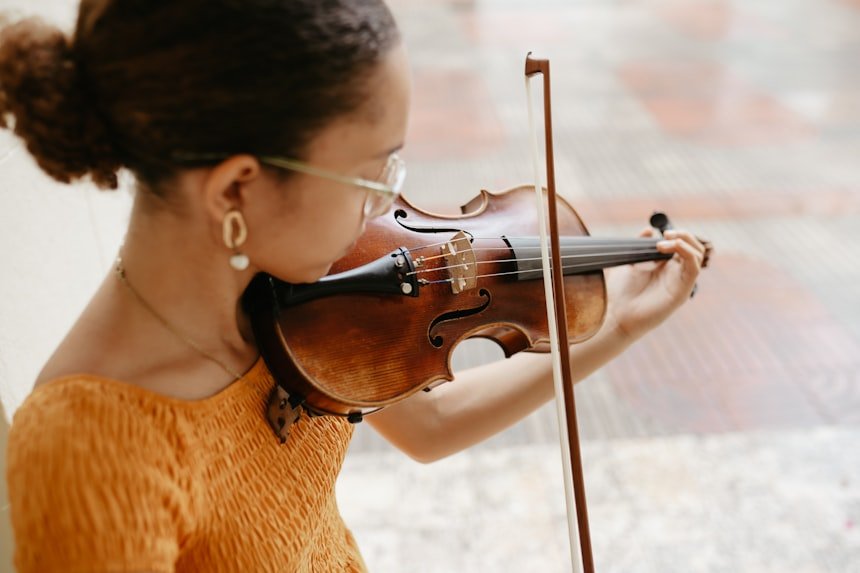
Woman in orange dress playing violin outdoors — advanced performance
This is where a solid foundation leads. Not locked into one style — free to play anything, anywhere.
The violin and music theory — a direct connection

Understanding how scales are built — which notes are a semitone apart, which are a whole tone — makes your child’s left hand more intelligent. A student who understands intervals is not guessing at finger placements. They are reasoning about them. Our music theory program and the virtual piano tool are both valuable for violin students — the piano’s visual layout makes intervals and scale structures tangible in a way the fingerboard alone cannot.

Practice tools for violin students
Free interactive tools — no login required. Use them every day.
On daily practice — the metronome is not optional

Twenty focused minutes every day produces more progress than two hours the night before a lesson. At the end of each session, your child receives a specific written practice plan — not “review your pieces” but exactly which measures, at which tempo, with which technical focus. The metronome is used in every practice session, every day. Students who practice without one are not practicing — they are rehearsing whatever rhythmic mistakes they already have.

Frequently asked questions
What age can my child start violin?
The youngest we typically begin is five. At that age, what matters is not the number but the readiness — can your child hold focus for 20–30 minutes, and do they genuinely want to play? A reluctant five-year-old will make slower progress than an enthusiastic seven-year-old every time. If you are not sure whether your child is ready, that is exactly what the evaluation is for. We will tell you honestly — even if the honest answer is to wait six months.
Do we need a violin before the first lesson?
No. Bring nothing to the evaluation. We assess your child first, then advise on the correct size — violins range from 1/16 for very young beginners to 4/4 for adults — and whether renting or buying makes sense at this stage. Buying the wrong size is one of the most common mistakes new violin families make, and it is entirely avoidable. We will point you toward reputable options in the area after the evaluation.
How long before my child plays a recognizable piece?
Most students play their first complete piece within four to eight weeks. It will not be a concerto — but it will be real music, something your child can play for grandparents at Thanksgiving and feel genuinely proud of. The first year builds the physical and musical foundation. Year two is when the repertoire starts to expand significantly. Many parents tell us they are surprised by how quickly that first year passes and how much their child has developed.
My child has bad habits from a previous teacher. Can those be fixed?
Yes — and we see this regularly. Bad habits are stubborn because muscle memory does not surrender easily. But they are correctable with patience and the right approach, typically within a few months of consistent focused work. The evaluation will identify exactly what needs to change. We will not build anything new on top of existing problems. We address the root first.
How important is rhythm in violin playing?
It is the skeleton everything else hangs on. A student with beautiful tone and poor rhythm is not making music — they are making sounds at irregular intervals. Rhythm is trained from the first lesson with a metronome, and it is reinforced in every practice session. Our sight reading exercises develop rhythmic fluency as a natural byproduct. You cannot separate rhythm from music. We never try to.
Are online violin lessons as effective as in-person?
For intermediate and advanced students, yes — fully effective. We can assess bow technique, intonation, and musicality clearly through video. For very young beginners, particularly under seven, in-person is preferable in those first weeks — physical guidance in the earliest stages makes a real difference. As soon as the physical baseline is established, online works beautifully. Many of our most consistent students study entirely online.
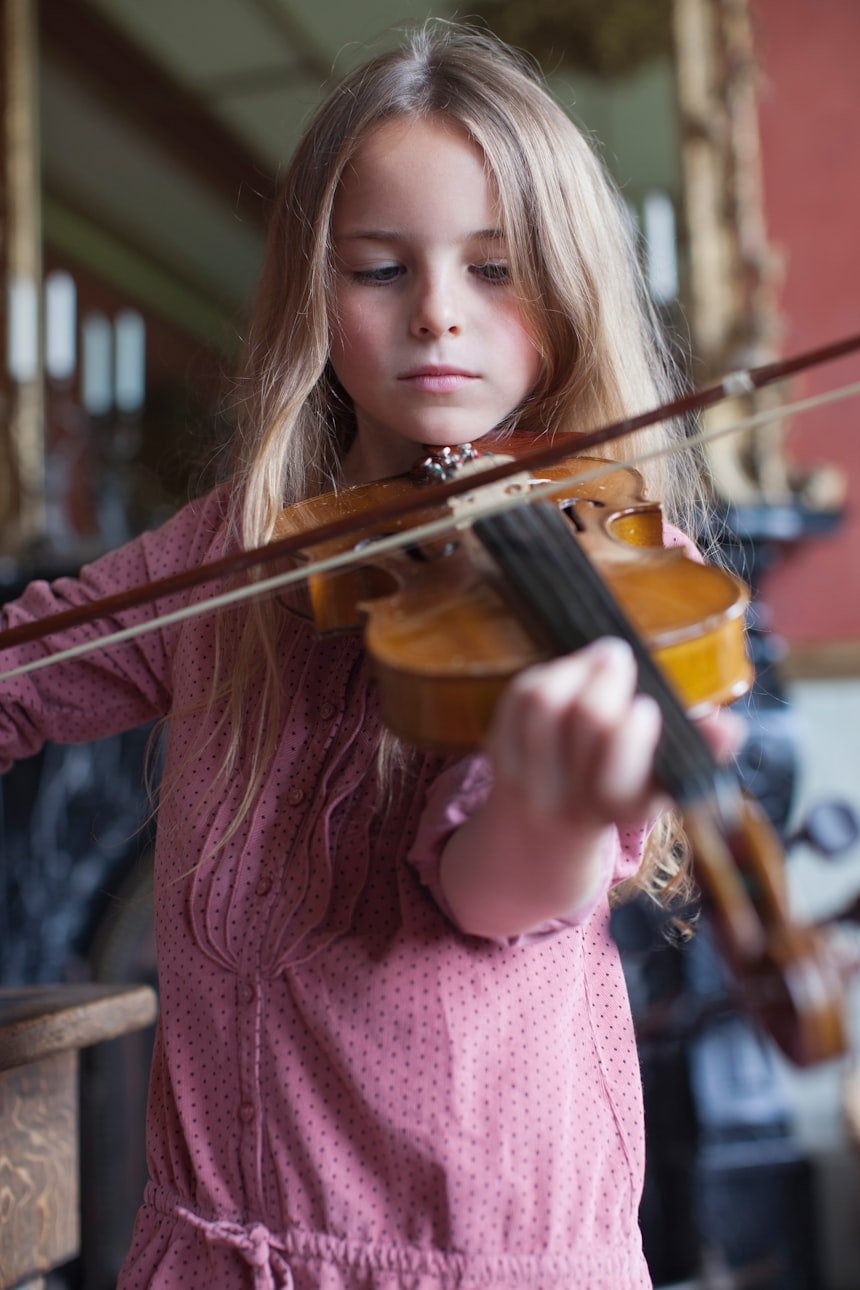
Little girl playing violin in a room — young student focused and engaged
Every student who goes on to perform, compete, or simply love music — started exactly here. With a 30-minute evaluation and no commitment.

Lesson details

Private 1-on-1Standard format — weekly, in-studio or online
Group programsAvailable after evaluation — 2–6 students
Online lessonsAvailable — intermediate & advanced
Ages5 and up
First step30-min private evaluation
PricingDiscussed on call

The right place to begin.

The evaluation is 30 minutes. No commitment, no pressure. We tell you exactly where your child is and exactly what the right path forward looks like — not from a generic book, but from this student, at this level, with these goals.

Soul Music Lessons offers private and group violin instruction across Alpharetta, Johns Creek, Suwanee, Cumming, Roswell, Milton, Duluth, Norcross, Peachtree Corners, Sandy Springs, Dunwoody, Sugar Hill, Buford, Woodstock, and the broader North Metro Atlanta area. Online violin lessons available worldwide. Schedule your evaluation.